ADVERTISEMENT
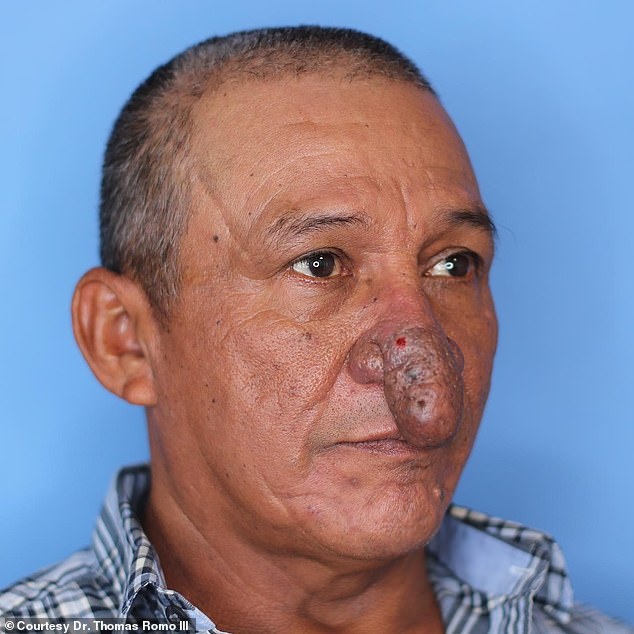
“I saw this gentleman working at my property when I noticed his severe case of rhinophyma,” Dr. Romo later wrote on social media. “I introduced myself and offered to correct his facial condition, to which he happily accepted.”
When Romo told Estrada what he intended to do, Estrada’s response was immediate and instinctive. “He saw me,” Romo recalled, “and he gave me a hug.”
The Condition That Had Taken Over His Life
Estrada was working at the home of Dr. Thomas Romo, the director of facial plastic reconstructive surgery at Lenox Hill Hospital in Manhattan
Rhinophyma is a progressive skin disorder that affects the nose. It is classified as an advanced form of rosacea — an inflammatory skin condition that causes redness, visible blood vessels, and skin texture changes primarily on the face. In most cases of rosacea, the condition remains manageable with topical treatments and lifestyle adjustments. But in some individuals, particularly men, rosacea can progress to a far more severe stage in which the tissue of the nose undergoes significant structural changes.
As rhinophyma develops, the sebaceous glands in the skin of the nose — the glands responsible for producing the skin’s natural oils — become dramatically enlarged. Scar-like tissue accumulates. The nose grows progressively larger, redder, and increasingly irregular in shape. The surface becomes coarse and uneven. In advanced cases, the deformity can become so pronounced that it alters the physical appearance of the face considerably and creates genuine functional impairment.
The condition is rare, and effective non-surgical treatments are limited. In many cases, surgical intervention is the only option capable of meaningfully reducing the enlargement and reshaping the nose. Even then, the procedure requires a surgeon with specific expertise — it is not a routine operation, and not every plastic surgeon has significant experience with it.
For Estrada, the condition had reached a stage that Dr. Romo described plainly as “a bad one.” There was a low-grade persistent infection involved, and without intervention, the doctor was clear about what would happen. “It would have just kept going,” he said.
ADVERTISEMENT
