ADVERTISEMENT
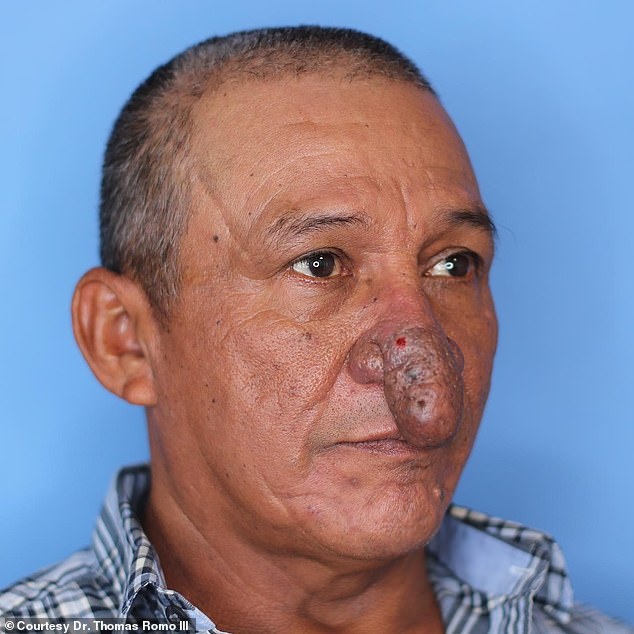
Estrada had not been passive in the face of his condition. He had spent six years actively seeking help, consulting multiple physicians and skin specialists, hoping each new appointment might bring a solution. Each time, he left without one.
In the meantime, the practical consequences of living with advanced rhinophyma accumulated steadily. The enlargement had progressed to the point where it was encroaching on his lips — so much so that when he took a bite of food, the spoon or fork would make contact with the tissue of his nose. Simply eating had become a daily challenge.
Breathing was another issue. The enlargement affected his airway sufficiently to cause heavy snoring during sleep, disrupting his rest night after night.
“They would stare at me,” he said. “Children would ask their mothers what happened to me — and I would get around it by using a face mask all the time.”
The professional impact was real as well. Dr. Romo, reflecting on what he observed when he first encountered Estrada, was direct about the broader implications of the condition.
The Operation
Just days after the chance meeting in Bronxville, Conrado Estrada was on the operating table at Lenox Hill Hospital. Dr. Romo performed the reconstructive procedure, reshaping the nose and removing the excess tissue that had accumulated over the years. Sterile bandages were applied, and the transformation began.
“I re-shaped his nose and applied sterile bandages,” Romo wrote. “He was so thrilled and thankful. There is no better satisfaction than being able to use my specialty and skill to improve another person’s quality of life.”
“Not many people know how to fix this condition, and health insurance will not necessarily cover it,” he noted.
A New Man
Estrada has described Romo as God having sent an angel to him
“It’s not just the shape of his face that’s changed,” Dr. Romo observed. “You’d think he won an Olympic gold medal. Chest out, head up, he’s a smiling guy. I feel great for him.”
The confidence that had been quietly eroded over years of stares, avoidance, and daily discomfort had returned. The man who had habitually worn a face covering to move through the world without drawing attention now moved through it differently — openly, freely, with his head up.
ADVERTISEMENT
